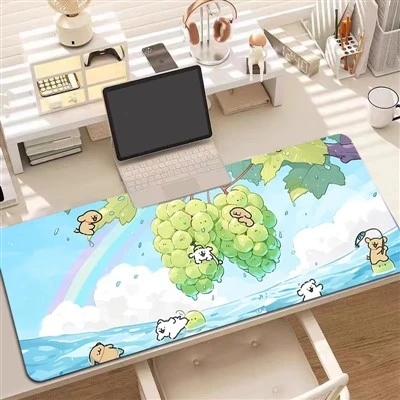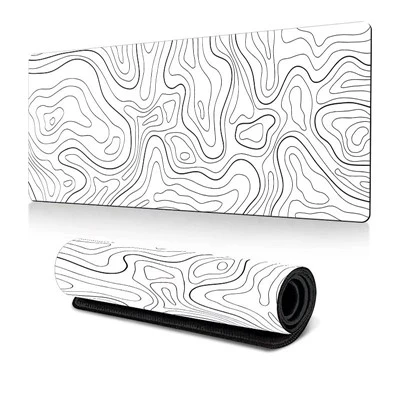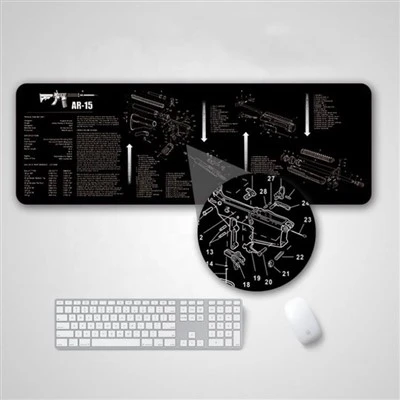

As we pass the halfway mark of 2026, the rubber and plastics industry is navigating raw material volatility and global supply chain restructuring along a clear trajectory. CHINAPLAS 2026, held at record scale, sent a definitive signal: the industry is accelerating its shift from "traditional manufacturing" to "smart green manufacturing," with downstream impacts reaching everyday consumer goods like mouse pads, yoga mats, and door mats.
Market Data: Mouse Pads & Yoga Mats – Billion-Dollar Tracks
Mouse Pads (including desk mats): Market estimates vary by methodology-ranging from $1.85B to $7.03B in 2025-but growth trends are consistent, projecting $2.6B to $10B by 2032, at a CAGR of 5.2%–5.4%. Key drivers: remote work, esports, consumer demand for high-precision surfaces and ergonomic designs, and smart features like wireless charging integration.
Yoga Mats (China focus): China's online yoga mat market reached RMB 1.56 billion in 2025 and is projected to hit RMB 1.65 billion in 2026 (iiMedia Research). Core drivers: deepening fitness culture and consumption upgrading-38.1% of fitness consumers spend RMB 600–900 annually. The top three purchase factors are quality (60.3%), sales volume (53.4%), and price (50.0%)-reputation for quality is now decisive.
For Manufacturers: Both markets show clear trends toward "quality upgrading" and "functional differentiation." Pure price competition is narrowing; material quality, ergonomic design, and eco-attributes are becoming the new hard criteria for winning orders.
CHINAPLAS 2026: How AI and Green Are Landing on Production Lines
CHINAPLAS 2026 set new records with 390,000+ sqm of exhibition space, 5,000+ global exhibitors, and 1,000+ "SRDI" enterprises on display-offering a clear technology roadmap for the years ahead.
Artificial Intelligence: From Concept to Shop Floor – Visible Productivity Gains
ENGEL's inject AI: iQ process observer autonomously analyzes production data and detects anomalies; iQ weight control automatically compensates for process fluctuations, stabilizing product weight and reducing startup scrap and defect rates.
KraussMaffei's ZE 180 twin-screw extruder: Designed for high-output demands, delivering 80%–90% capacity improvement over previous generations-a milestone in localizing large-scale extrusion equipment.
For Manufacturers: Digitalization and AI are turning "lean management" from rhetoric into reality. For high-volume producers of mouse pads, yoga mats, etc., reducing scrap rates and improving batch consistency through smart manufacturing builds dual competitive advantages in cost and quality.
Green Materials: From "Nice-to-Have" to "Entry Ticket"
Circular economy and sustainability have become supply chain imperatives. The show featured extensive displays of:
Post-consumer recycled (PCR) materials, chemically recycled materials, and biodegradable options.
Clariant's fluorine-free polymer processing aids balancing environmental performance with functionality.
Closed-loop technologies: bottle-to-bottle recycling systems, food-grade regranulation, AI-powered sorting equipment-unlocking critical circular economy pathways.
Emerging Frontiers: Plastics Are Defining Flying Cars & Humanoid Robots
Covestro showcased partner Govi's AirCad flying car, demonstrating systemic material capabilities from lightweight polycarbonate windows to battery safety encapsulation foams and sustainable coatings.
Kraiburg TPE's translucent TPE materials and BASF's lightweight polyamide series enable new combinations of "soft-touch" and "optical expression" in humanoid robots and smart cockpits.
For Manufacturers: While these frontier applications are far from traditional mat production lines, the "upward breakthrough" of material technology will drive upgrades across the board-whether greener TPE/natural rubber formulas for yoga mats or more durable, antimicrobial surface coatings for mouse pads. Innovation at the material level ultimately benefits every niche.
Outlook: The "Quality Race" Under Dual Drivers
By 2026, the rubber and plastics industry has clearly charted a dual-course: smart for efficiency, green for quality. For manufacturers of mouse pads, yoga mats, and door mats, signals from both downstream markets and upstream exhibitions point in the same direction:
"High quality, differentiation, and sustainability" are replacing "low cost, mass volume, and homogeneity" as the new compass for global order flows. Whether through smart production to reduce scrap or early adoption of greener formulations, those who act first will secure a competitive edge in the coming industry shakeout.